Conference paper: Understanding thermal-induced second order stresses in steel beams under fire
Steel beams rarely behave in isolation during a fire. While simplified fire design methods often assess individual members under idealised conditions, real buildings behave as interconnected structural systems. As temperatures rise, restrained thermal expansion can generate additional axial forces, bending moments and second-order effects, raising important questions about how these interactions influence structural performance and whether simplified design methods remain appropriate.
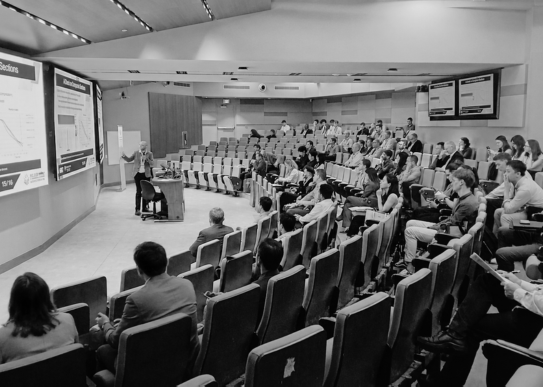
At the 14th International Conference on Structures in Fire, held in Kingston, Canada, BB7’s Lefteris Koutsoloukas presented a conference paper, co-authored alongside Sean Enright, Master’s Student at Johns Hopkins University, Juan Martinez, Technical Associate Director at BB7, David Baron, Director of Advanced Engineering at BB7 and Thomas Gernay, Associate Professor at Johns Hopkins University, exploring how thermal restraint influences the fire response of steel beams and whether simplified design methods remain appropriate under these conditions.
The paper, Parametric Analysis of Thermal-Induced Second-Order Stresses in Steel Beams Under Fire Exposure, focuses on how axial and rotational restraints affect the behaviour of steel beams exposed to fire. Using an extensive programme of numerical modelling, the research examines whether restraint-induced forces significantly influence the critical temperature at which steel beams fail in bending, providing valuable insight into whether the application of current Eurocode design methods continues to provide reliable predictions of fire resistance in real structures.
Understanding the challenge
Simplified fire design methods, such as the critical temperature approach within EN 1993-1-2, are widely used to verify the fire resistance of steel structures. These methods typically assess individual members, assuming uniform temperatures without considering the influence of the surrounding structure.
In practice, surrounding structural members restrain thermal expansion, generating additional axial forces, bending moments and second-order effects that influence structural behaviour during fire. While previous experimental and analytical studies have demonstrated that restraint affects internal forces and deformations, uncertainty has remained over whether these effects significantly alter the critical temperature at which bending failure occurs.
Understanding this behaviour is important, as it helps determine whether simplified design methods remain appropriate for practical engineering applications or whether more advanced analysis is required when restraint is present.
Investigating restrained steel beams under fire
To better understand this behaviour, the researchers carried out a comprehensive parametric numerical study using the finite element software SAFIR.
More than 5,000 numerical simulations were undertaken, covering a wide range of beam sizes, spans, applied load ratios and combinations of axial and rotational restraint. The study evaluated IPE sections ranging from IPE 80 to IPE 600, considering varying restraint stiffness and restraint positions to represent realistic interactions between steel beams and the surrounding structure. This extensive dataset enabled the research team to systematically investigate how restraint conditions influence beam behaviour during fire exposure and compare the numerical results against the simplified critical temperature method provided within Eurocode 3.
Each beam was first analysed under ambient conditions, then subjected to increasing temperatures until failure. This enabled the research team to compare failure temperatures across thousands of different structural scenarios while assessing the influence of restraint relative to the applied load.
Key findings from the study
The study demonstrated that restraint significantly influences how steel beams behave during a fire, particularly with respect to thermally induced forces and structural deformations.
As expected, restrained thermal expansion generated compressive forces within the beam during the early stages of heating, leading to considerably larger vertical deflections than in unrestrained members. In some cases, these compressive forces transitioned into tensile catenary action as deformations increased.
Perhaps the most significant finding, however, was that these restraint effects did not consistently reduce the critical temperature for bending failure.
Instead, the analysis identified the applied load ratio as the dominant factor governing failure temperature. Across thousands of numerical simulations, no consistent adverse effect of axial restraint on the bending failure temperature was observed. The numerical results also showed good agreement with the simplified critical temperature method provided in Eurocode EN 1993-1-2, supporting its continued application for compact steel beams subjected to uniform heating.
Why this matters for structural fire engineering
For practising structural fire engineers, understanding the interaction between restrained thermal expansion and member resistance is essential when assessing the behaviour of real structures during fire.
This research provides further confidence that the simplified Eurocode critical temperature method can generally be applied to restrained Class 1 and Class 2 steel beams subjected to uniform heating for resistance verification. At the same time, it highlights the importance of considering restraint-induced deformations and forces when assessing wider structural behaviour, particularly the effects on connections and non-structural elements.
By combining advanced numerical modelling with practical engineering applications, the research contributes to the ongoing development of structural fire engineering knowledge while helping engineers better understand the behaviour of restrained steel structures exposed to fire.
Download the full conference paper
Lefteris’ full conference paper provides a more detailed technical discussion of the numerical modelling methodology, parametric analysis, restraint conditions and engineering implications presented at the conference.
To explore the findings in more detail, complete the form below to download the full paper: