Academic research on thermal-induced stresses in isolated beams subjected to fire

At BB7’s Innovation Lab, we are committed to pushing the boundaries of fire engineering. One of the exciting ways we do this is by working closely with universities around the world, combining academic research with real-world practical engineering.
Recently, our team collaborated with Johns Hopkins University on a research project investigating the behaviour of structures under fire conditions. The study, led by graduate researcher Sean Enright and supervised by Associate Professor Thomas Gernay, examined how thermal stresses influence the performance of isolated beams when exposed to high temperatures. In particular, the research explored how factors such as restraints at the ends of beams can significantly affect structural response – a topic where knowledge is still developing in the field of fire engineering.
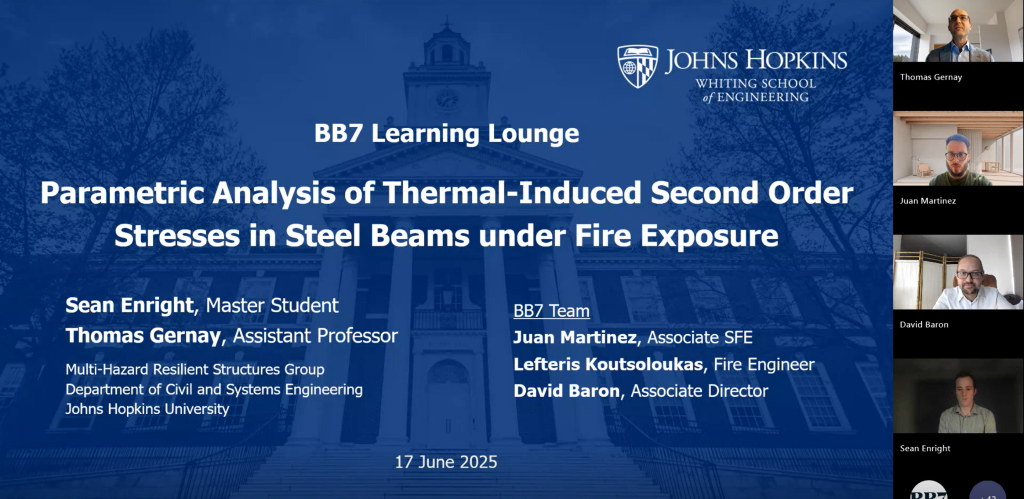
The study provides valuable insight into how simplified design approaches perform when applied to complex, real-world scenarios. This kind of work supports engineers in making informed decisions that prioritise safety, while also testing the reliability of established design methods under challenging conditions.
What makes this collaboration especially valuable is the combination of perspectives. By bringing together BB7’s practical fire engineering expertise with the academic rigour of Johns Hopkins University, the project not only advances knowledge but also highlights the importance of industry–academia partnerships. These collaborations allow us to share expertise, challenge assumptions, and ultimately contribute to safer, more resilient buildings.
We are incredibly grateful to Sean Enright and Professor Thomas Gernay for their dedication and expertise throughout this project. Their work represents a step forward in understanding how structures respond to fire, and we look forward to exploring further opportunities for research that continues to push the field of fire engineering forward.