Conference paper: Understanding the fire response of Y-shaped steel columns
Y-shaped steel columns, often known as Y-posts, are a familiar feature in transport hubs, stadia, atria and other large-span spaces. Architecturally, they help create open, visually striking environments. Structurally, however, their geometry can introduce complex behaviours when exposed to fire.
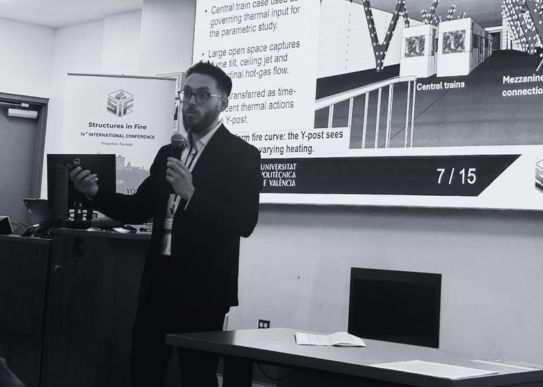
At the 14th International Conference on Structures in Fire, held in Kingston, Canada, BB7’s Juan Pagán‑Martínez presented a conference paper, co-authored alongside Ignacio Payá‑Zaforteza, Professor in Structural Fire Engineering at the Universitat Politècnica de València, exploring how Y-shaped steel columns behave under different fire scenarios, and why their response cannot always be understood through conventional approaches used for prismatic columns or standard frame systems.
The paper, Parametric Numerical Study of Y-Shaped Steel Columns in Fire, focuses on a steel Y-post taken from the global structural model of an intermodal transport terminal in Alicante, Spain. Through a detailed parametric numerical study, the research investigates how non-uniform heating, asymmetric thermal exposure and local fork detailing can influence structural performance in fire.
Why Y-shaped columns behave differently in fire
Unlike a standard vertical column, a Y-post has a forked geometry where two inclined arms meet the stem. In a fire, this creates a different set of challenges.
When one arm heats more than the other, or when temperature varies along the height and length of the post, the structure can experience incompatible thermal strains. This can trigger rotation at the fork, redistribution of load between the arms and stem, and additional demand on connected elements such as mezzanines.
These behaviours are not always captured by simplified design assumptions, particularly where standard nominal fire curves are used without considering the actual fire environment, ventilation conditions or spatially varied heating.
A performance-based approach to understanding structural fire response
The study compares CFD-derived natural fire exposure with nominal fire curves, including an asymmetric heating scenario designed to isolate the effect of temperature differences between the two arms of the Y-post.
Using thermal actions from a Computational Fluid Dynamics fire model, the paper examines the structural response of the Y-post under realistic, non-uniform heating. This is then compared with standardised exposure scenarios to understand how different modelling approaches can affect predicted performance.
The analysis considers:
- fork rotation and vertical displacement
- axial force redistribution between the arms and stem
- demand transferred into the mezzanine connection
- local deformation at the fork using complementary shell modelling
- the influence of local instability representation in fibre-beam models
Key findings from the study
The results show that the forked geometry of Y-posts can produce a distinctive structural fire response, particularly where heating is non-uniform or asymmetric.
One of the central findings is that small differences in arm temperature can lead to significantly different deformation patterns. In asymmetric heating scenarios, load can migrate between the hotter arm, colder arm and stem as stiffness changes during the fire. This load-path switching is a key consideration for performance-based structural fire engineering assessments.
The study also highlights the importance of mezzanine connections. Rather than being affected only by external lateral actions, the mezzanine link can be mobilised by thermally induced distortion of the Y-post itself. In some scenarios, the connection force may reverse direction, suggesting that such connections should be considered for both tension and compression.
Local fork detailing is another important theme. While beam models are useful for efficient system-level analysis, shell modelling revealed local deformation concentrations and plate instability patterns at the fork. This points to the potential need for targeted stiffening, weld reinforcement or plate thickness adjustments depending on the governing design conditions.
Why this matters for complex buildings
For large, open structures such as transport terminals, stadia and atria, architectural ambition and structural performance are closely linked. Y-posts can play an important role in achieving open spaces and long spans, but their behaviour in fire requires careful consideration.
This research reinforces the value of performance-based structural fire engineering, particularly where the geometry, fire scenario or connection arrangement falls outside standard assumptions. By understanding the mechanisms that drive fire response, project teams can make more informed decisions about modelling strategy, passive fire protection, connection detailing and overall structural resilience.
Download the full conference paper
Juan’s full conference paper provides a more detailed technical discussion of the modelling approach, fire scenarios, thermal analysis, structural response and conclusions from the parametric study.
To explore the findings in more detail, complete the form below to download the full paper: