A case for integrated fire and façade consultancy services
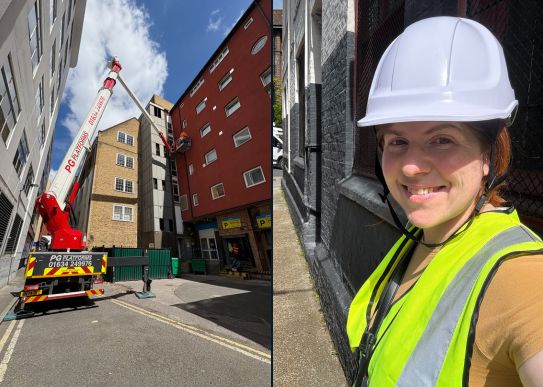
Time has flown: I’ve now been at BB7 for over 2 years, and it’s been a period of deep learning and discovery.
I joined with 14 years’ experience in façade engineering, including six focused on fire-related recladding. Despite this level of experience, I often found myself being challenged by our in-house fire engineers or relying on their guidance in situations I thought I knew well. This highlighted that I was still missing a key piece of the puzzle, not fully understanding the critical drivers behind their input.
That changed when I was seconded two days a week into BB7’s Fire Assurance and Risk Management (ARMS) team. Working alongside fire engineers on projects ranging from recladding and FRAEWs to research into BS 8414 rig design has been eye-opening.
What surprised me most?
The extent to which internal layouts and building fire strategies impact the risk associated with the fire performance of façades. Traditionally, façade consultants have limited involvement in internal building layout considerations, yet decisions like stair core and corridor placement can significantly affect recladding scope and residual risk. PAS 9980 has helped expose this need, but full integration of the internal layouts and fire strategy with the external wall is still rare.
The depth of fire engineers’ knowledge of materials, goes far beyond surface classifications.
Understanding how materials burn, not just their Heat Release Rates or EN 13501-1 classification, and how this may impact escape and firefighting operations in different buildings has shifted how I approach façade design. The lived experience of colleagues from fire services and testing houses has been invaluable.
The overlooked role of façades in Building Regulation B5 compliance.
Events like the Aldgate fire in 2024 demonstrate that falling glass and cladding materials pose real risks to firefighters. As traditional masonry returns to high-rise construction, this risk grows, and façade professionals must take it seriously.
So what’s the root of the challenge?
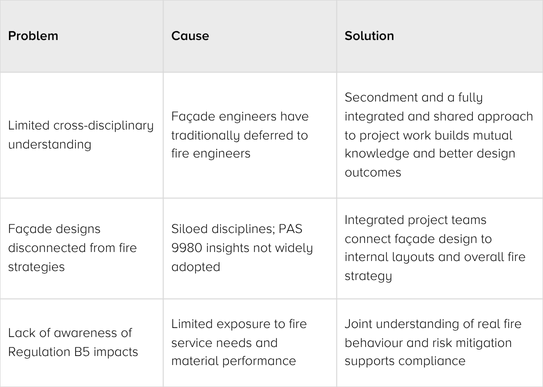
At BB7, we’ve started to address these issues by consciously embedding cross-disciplinary collaboration into our work. Façade consultants are working on FRAEW assessments; fire engineers are reviewing combustibility schedules and drawings in detail. We’re breaking down silos, one project at a time.
But true integration takes more than cooperation, it takes commitment.
We need individuals willing to train outside their discipline, to learn from each other, and to challenge conventional boundaries. Only then can we deliver buildings that are not only compliant, but genuinely safer.
Written by Camille Destres CEng MCIBSE MSFE, Associate Director of Façade Engineering
For and on behalf of BB7